🌐 Hyperlocal Services Platform
Role: Senior Ruby on Rails Engineer
Company: Partner Vision InfoTech, Guangzhou, China
Period: Oct 2019 – Dec 2021
1. 📝 Project Summary
A local life web platform providing exclusive products, resource monetization, and community interaction for users in the Guangzhou area.
Core Business Modules:
- Product & Service: Exclusive discounts, coupons for hotels, flights, gyms, restaurants, and entertainment
- Resource Monetization: Platform for users to leverage valuable personal or professional connections
- Community: Social circles for user interaction, content sharing, and engagement
Key Impact:
- Enabled users to access competitive local products and services
- Facilitated resource monetization and business networking
- Built a stable, scalable web platform supporting fast iteration and business adjustment
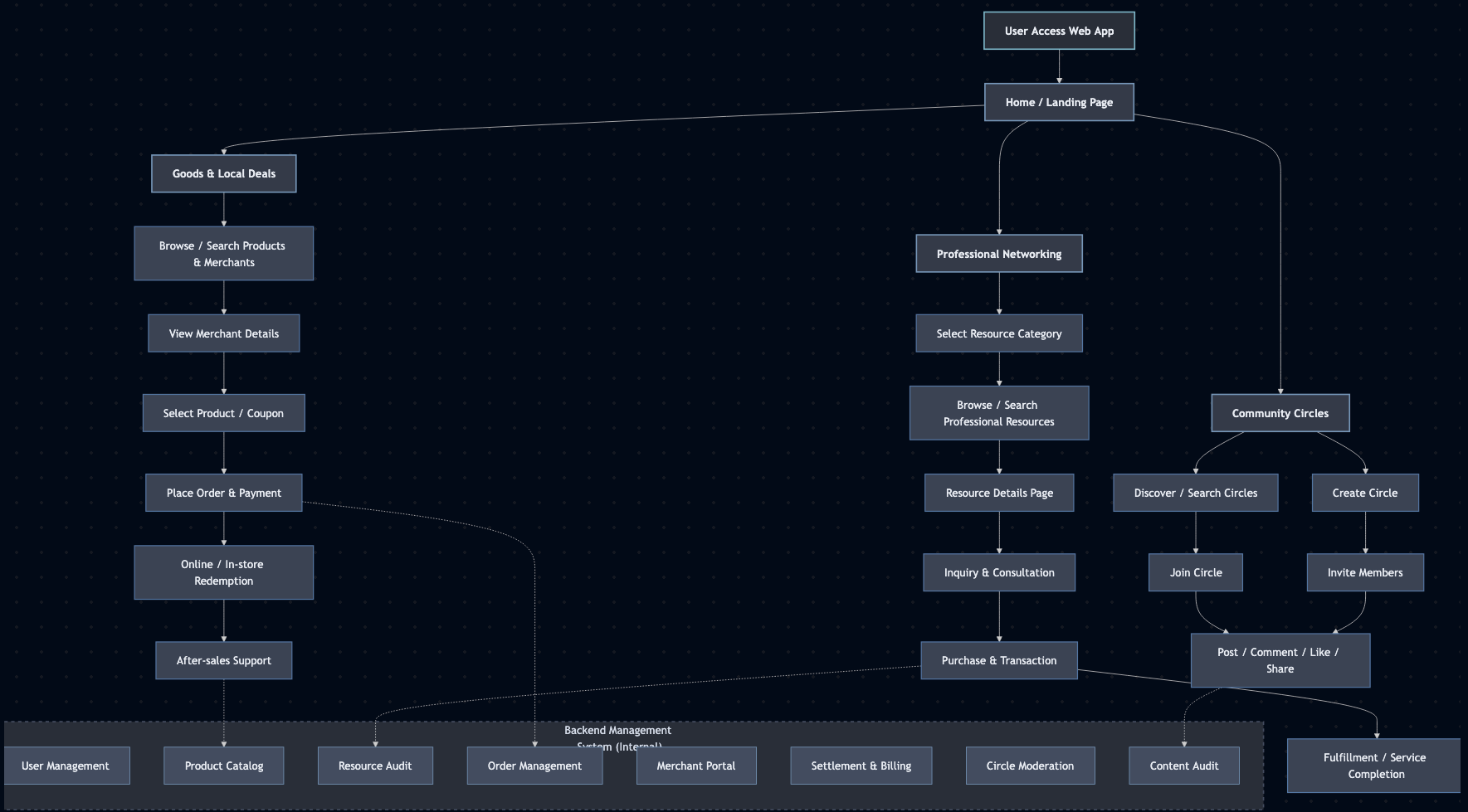
2. 🧭 User & Data Flow
Front-end (User-facing):
- User logs in and selects a business module: Products, Resource Network, or Community
- Product Module: Browse products, search merchants, view details, place orders, and redeem online/offline
- Resource Module: Search resources, view details, consult, place requests/orders, handle after-sales
- Community Module: Create/join circles, post, comment, like, share, and interact with other users
Back-end (Admin-facing):
- Manage users, products, resources, orders, merchants, settlements, circles, and posts
- Admins log in to manage each module efficiently
Description: End-to-end workflow supports both user-facing interactions and admin management, ensuring smooth operations and fast business adaptation.
3. 🏗 System Architecture
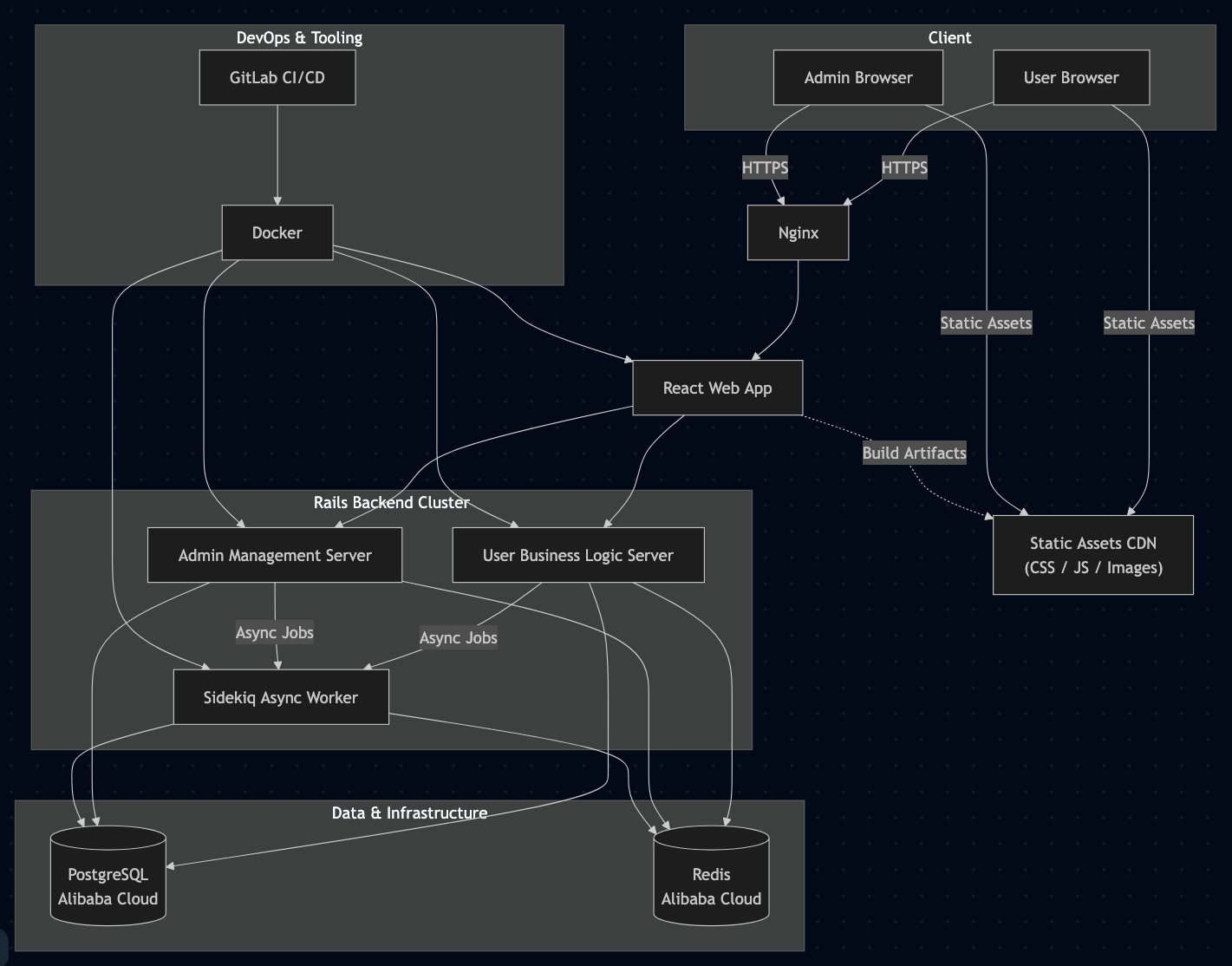
Core Components:
- Web App: React frontend served via Nginx
- Rails Backend: Three servers
- User business logic server
- Admin management server
- Sidekiq server handling all asynchronous tasks
- Database: Alibaba Cloud PostgreSQL for persistent storage
- Cache: Alibaba Cloud Redis for caching and locking
- DevOps & Tools: Docker, GitLab CI/CD, Nginx, Redis
Highlights:
- Modular separation of user, admin, and async tasks ensures scalability and maintainability
- Async workflows allow fast processing of orders, notifications, and background jobs
- Architecture supports rapid iteration for fast business experiments and adjustments
4. ⚡ Technical Challenges & Solutions
| Challenge | Solution |
|---|---|
| Rapid product iteration & changing business requirements | Designed flexible modular backend, enabling fast updates without downtime |
| Handling multiple business modules (products, resources, community) | Modular Rails servers and React frontend, each module independently deployable |
| High concurrency for product orders and resource requests | Redis caching and Sidekiq-based asynchronous processing to ensure reliability |
| Ensuring system stability during fast deployment | Dockerized servers and CI/CD pipelines for consistent, stable releases |
5. 👨💻 My Responsibilities & Achievements
- Full lifecycle development: Responsible for all three core business modules and admin backend
- Requirements gathering & integration: Collected, reviewed, and consolidated large volumes of third-party business requirements
- Communication & coordination: Worked closely with stakeholders and vendors to ensure smooth system integration
- Architecture & implementation: Designed backend architecture, database schema, async workflows, and frontend modules
- Deployment & stability: Managed deployment, monitoring, and fast iterations to enable business experiments
- Key Strengths Highlighted: Independent development, cross-team coordination, rapid prototyping, and end-to-end system delivery
- Outcome: Delivered a stable, fully functional local life platform that allowed the business to scale quickly, adjust products and services, and reduce operational costs