Distribution E-commerce Platform
High-Concurrency Flash Sale & E-commerce distribution system
Role: Senior Ruby on Rails Engineer
Company: Guangzhou Lige InfoTech
Period: Sep 2015 – Oct 2017
1. Project Summary
The Distribution E-commerce Platform was a high-concurrency social commerce system focused on group buying, flash sales, and a three-level referral distribution model.
The platform leveraged WeChat-based social networks as the primary growth and sales channel. Group leaders promoted exclusive, limited-quantity products within private groups, driving highly synchronized purchase behavior during flash sale events.
Each successful order triggered multi-level commission settlements, making the system both performance-critical and financially sensitive.
Key Scale Characteristics:
- Sustained 4,000+ QPS peak traffic during flash sale events with highly synchronized user behavior
- Large-scale order bursts generated within seconds, each triggering multi-level commission fan-out
- Extreme write amplification caused by inventory deduction, order creation, and financial settlement
- Real-world backend challenge combining burst traffic control, inventory consistency, and complex commission calculations
2. User & Data Flow
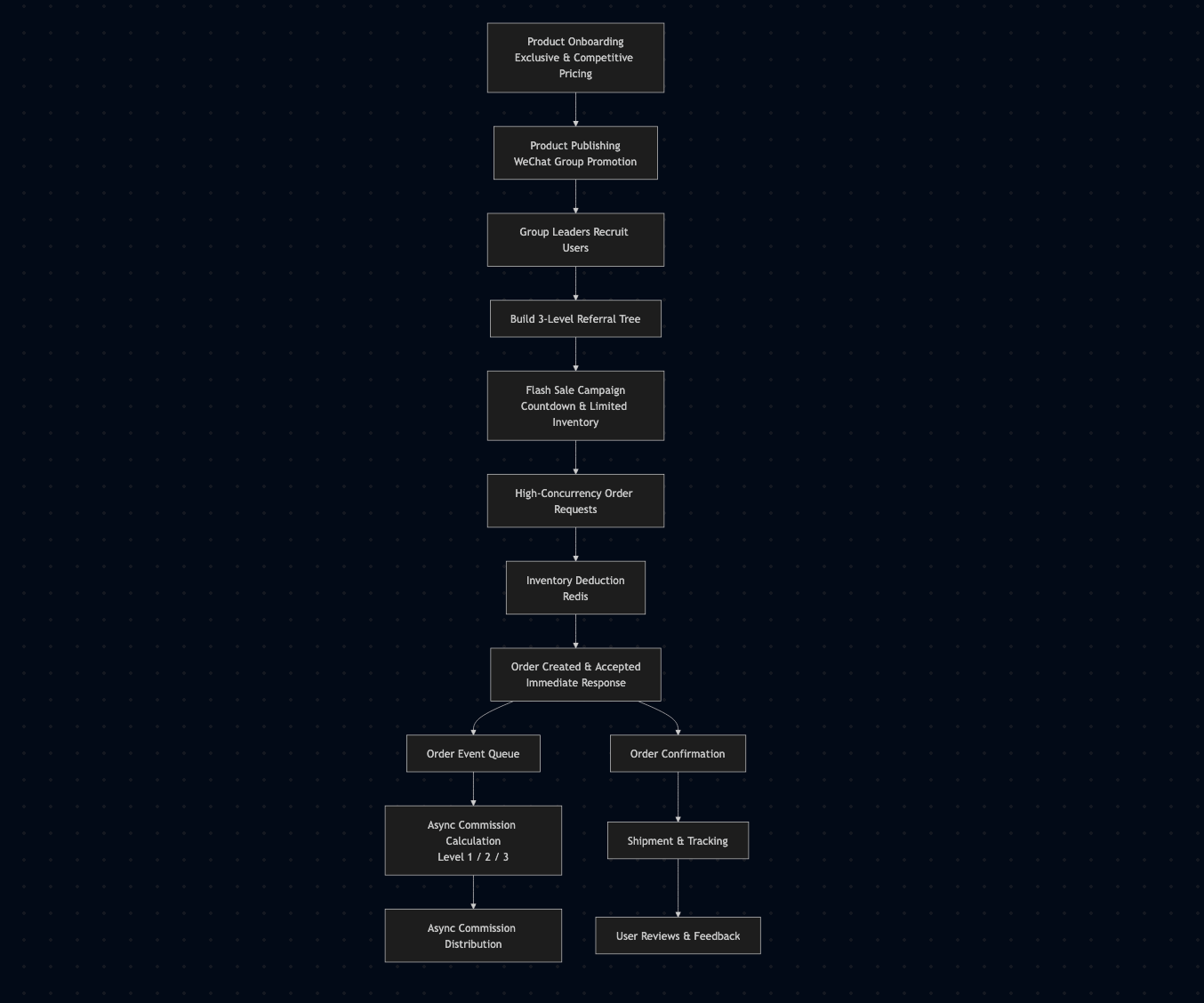
User Journey (Social Commerce Flow)
- Platform operators onboard exclusive, competitively priced products.
- Products are published and promoted via WeChat group channels.
- Group leaders recruit users and establish multi-level referral relationships.
- Flash sales are launched with countdown timers and limited inventory.
- Users place orders simultaneously when the sale opens.
- Inventory is deducted atomically to prevent overselling.
- Orders are accepted immediately; heavy processing is deferred.
- Commission rewards are calculated and distributed across referral levels.
- Users receive confirmations and track fulfillment.
Admin & Management Flow (Backend Operations)
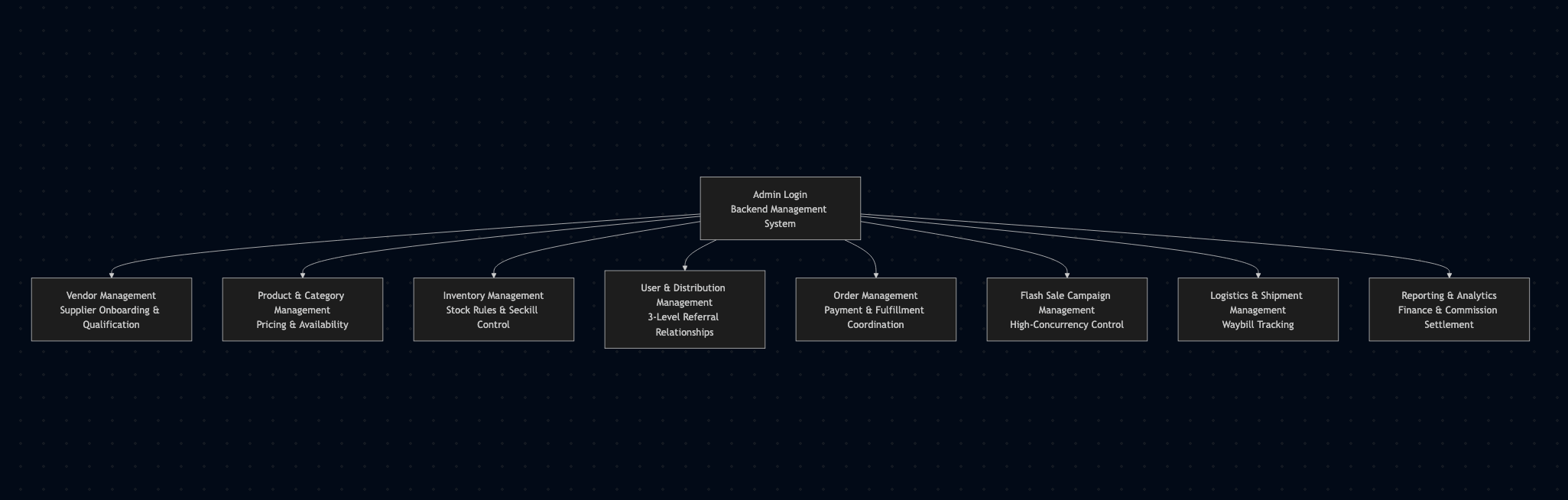
Administrators log into the backend management system to operate and control the entire business lifecycle.
Key management modules include:
-
Vendor Management
Supplier onboarding, qualification, and product source maintenance. -
Product & Category Management
Managing product listings, categories, pricing, and availability. -
Inventory Management
Stock monitoring, inventory deduction rules, and flash sale stock control. -
User & Distribution Management
Managing users, group leaders, and three-level referral relationships. -
Order Management
Order lifecycle tracking, payment status, and fulfillment coordination. -
Flash Sale Campaign Management
Creating, scheduling, and controlling high-concurrency seckill events. -
Logistics & Shipment Management
Shipment tracking and logistics waybill management. -
Reporting & Analytics
Operational metrics, financial reports, and commission settlement analysis.
The admin system ensured full operational visibility and control, especially during high-risk flash sale campaigns.
Data Flow Characteristics
-
Hot path (synchronous):
Authentication → inventory check → atomic stock deduction → order acceptance -
Cold path (asynchronous):
Order persistence, commission calculation, balance updates, notifications
3. System Architecture
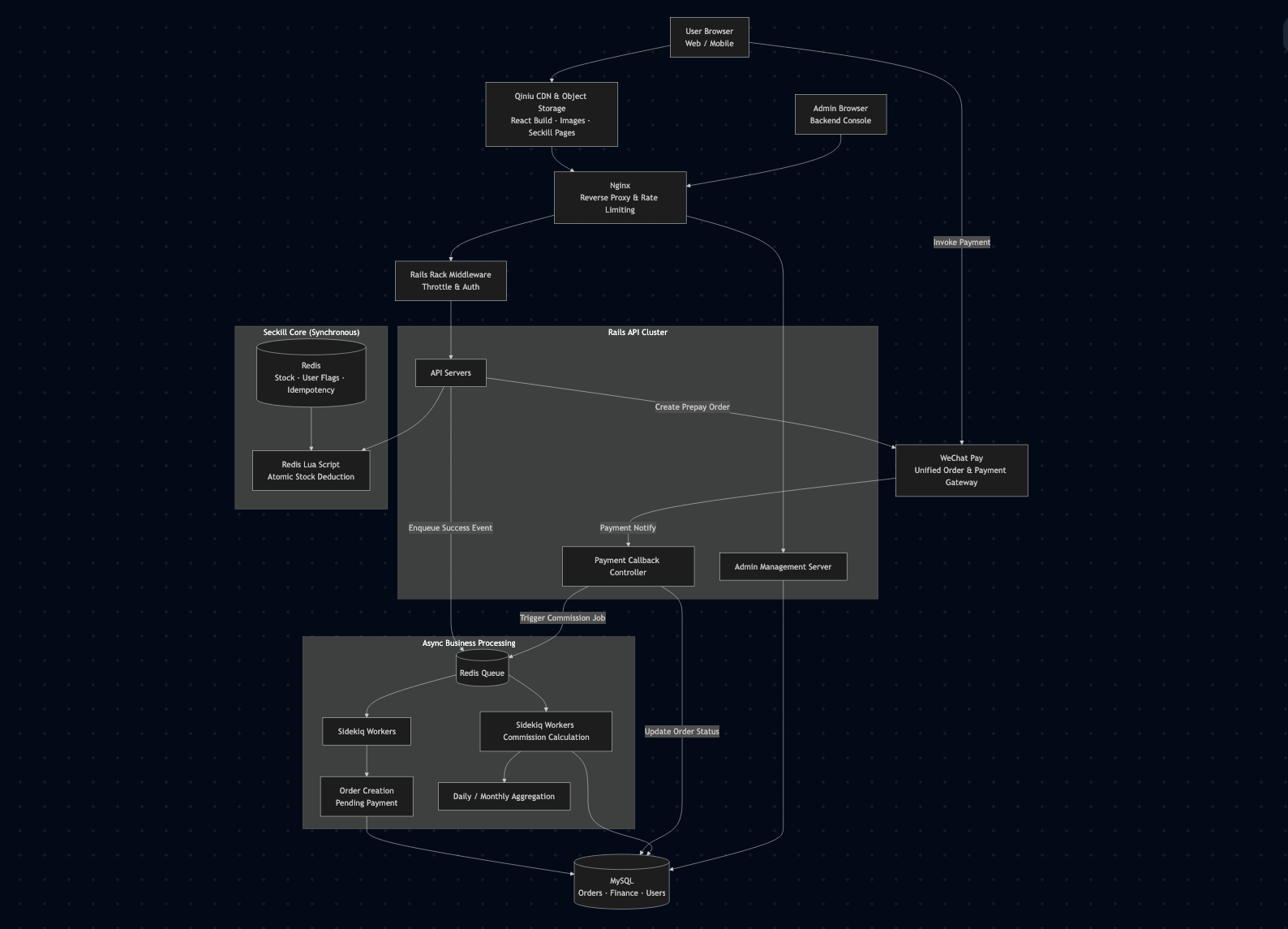
Core Architecture
- Web Server: Nginx (reverse proxy & basic rate limiting)
- Backend: Ruby on Rails (Puma)
- Cache & Locking: Redis
- Async Processing: Sidekiq
- Database: MySQL
- Deployment: Linux-based servers
Architectural Principles
- Redis acted as the concurrency gatekeeper, handling all flash sale inventory logic.
- Rails controllers were intentionally lightweight to survive traffic bursts.
- Sidekiq handled all heavy and non-critical workflows asynchronously.
- Strict separation between request acceptance and financial processing.
4. Technical Challenges & Solutions
High-Concurrency Flash Sales
Challenge
During flash sales and promotional events, the platform experienced extreme traffic spikes, with thousands of users attempting to place orders simultaneously.
Key challenges included:
- Risk of inventory overselling under high concurrency
- Database overload caused by hot product and stock queries
- Increased latency due to repeated frontend asset and product data requests
- Cascading failures across order, payment, and inventory subsystems during peak QPS events
Solution
To ensure system stability, data consistency, and smooth user experience under high load, a multi-layered high-concurrency architecture was implemented:
Frontend & CDN Optimization
- Static assets (JavaScript, CSS, images) were served via CDN to reduce application server pressure.
- Product metadata, pricing, and availability flags were preloaded into Redis before flash sales.
Inventory Control & Atomicity
- Inventory data was pre-warmed into Redis and treated as the primary source of truth during flash sales.
- Redis were used to perform atomic stock validation and deduction, preventing race conditions and overselling.
- Requests exceeding available stock were rejected at the cache layer to avoid unnecessary backend processing.
Backend Load Protection
- Direct database writes were eliminated from the critical purchase path.
- Order creation, payment confirmation, inventory synchronization, and notifications were processed asynchronously using Sidekiq.
- Redis acted as both a cache and a background job queue, smoothing traffic bursts and protecting downstream systems.
Asynchronous & Event-Driven Processing
- Payment callbacks, inventory reconciliation, and financial calculations were handled asynchronously.
- Idempotent job execution ensured consistency under retries and partial failures.
- Backend services remained responsive even during peak QPS events.
Three-Level Distribution Commission Logic
Challenge:
Each order triggered multiple dependent financial calculations.
Solution:
- Cached referral relationships in Redis.
- Moved commission calculation entirely to Sidekiq.
- Asynchronous write-back buffering and flattened data indexing.
System Stability Under Traffic Spikes
Challenge:
The legacy system frequently crashed during promotions.
Solution:
- Refactored flash sale and commission modules.
- Introduced async pipelines and strict execution boundaries.
- Applied conservative capacity planning with intentional redundancy.
5. My Responsibilities & Achievements
Responsibilities
- Led the refactoring of the flash sale system.
- Designed high-concurrency inventory control mechanisms.
- Optimized the multi-level commission settlement module to handle high-concurrency spikes, increasing system throughput.
- Improved database models and performance.
- Stabilized the platform for large-scale promotional events.
Key Achievements
- Enabled the system to handle 4,000+ QPS during peak flash sales without downtime.
- Optimized the entire order and commission processing workflow, reducing server load and improving efficiency.
- Significantly lowered infrastructure costs through performance tuning and resource optimization.
- Delivered a robust, scalable, and maintainable system capable of supporting rapid business growth and frequent high-concurrency campaigns.