Court Case Management System (Judicial Platform)
Company: Beijing Jingyu Network Technology (Judicial Systems)
Role: Senior Ruby on Rails Developer
Period: Nov 2017 – Oct 2018
Domain: Judicial Informatization / Court Case Processing Systems
1. Project Summary
The Court Case Management System is a judicial case-handling platform designed to digitize, automate, and optimize the entire lifecycle of court proceedings.
The system significantly reduced manual workload for court staff by:
- Automating document ingestion and structuring
- Digitizing case filing and trial preparation workflows
- Assisting judges in legal research, judgment drafting, and case review
- Enabling knowledge reuse through structured archival
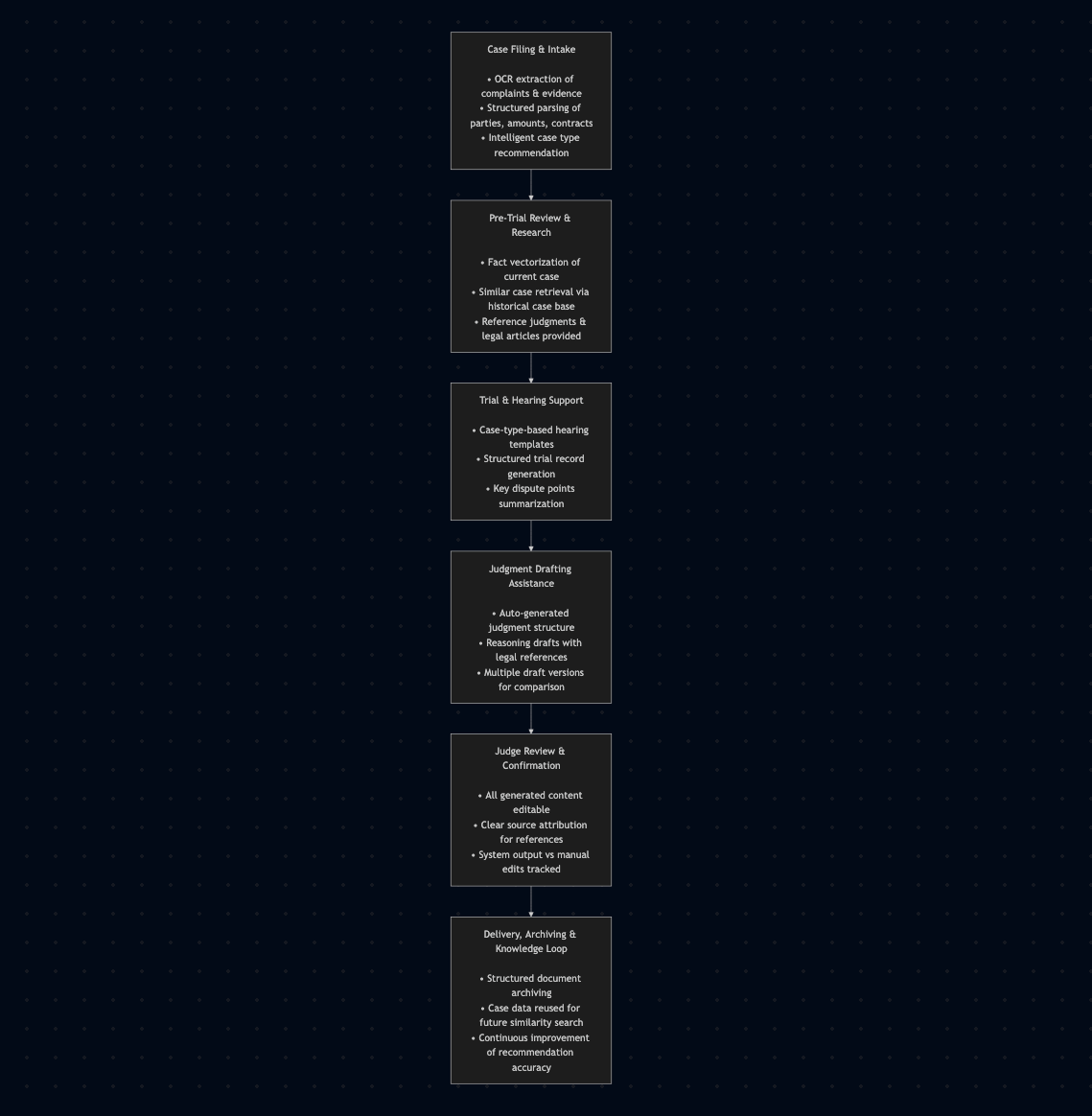
Project Flow: Intelligent Judicial Assistance System
2.1 Case Filing
Traditional Workflow
- Plaintiffs submit complaints, identity documents, and evidence (PDFs, scans, images).
- Filing clerks manually enter case details (category, parties, amounts).
Pain Points
- Inconsistent formats and high-volume repetitive data entry.
System Solution
- OCR & Structured Parsing: Extract text and identify key entities (Plaintiff, Monetary amounts, etc.).
- Intelligent Recommendation: Based on historical data.
2.2 Pre-trial Review
Traditional Workflow
- Judges manually search laws and similar cases based on personal experience.
Pain Points
- Time-consuming and inconsistent document review.
System Solution
- Automatic Similar Case Retrieval: Vectorize key facts to find the Top 5 similar historical cases.
2.3 Trial & Hearing
Traditional Workflow
- Manual note-taking and high effort in organizing Trial records.
System Solution
- Template-Based Hearings: Predefined question templates by case type.
2.4 Judgment Drafting
Traditional Workflow
- Even simple cases take 1–2 hours for drafting and legal research.
System Solution
- Automated Draft Generation: Combines current facts with patterns from similar judgments.
- Key Design Principle: System provides reference versions only; no auto-generated final verdicts.
2.5 Judge Review & Confirmation (Human-in-the-loop)
- Full Control: All system-generated content is fully editable and traceable.
- Auditability: Records machine-generated vs. judge-modified content for legal accountability.
2.6 Delivery & Knowledge Feedback
- Archiving: Final judgments are automatically stored in structured form.
3. System Architecture
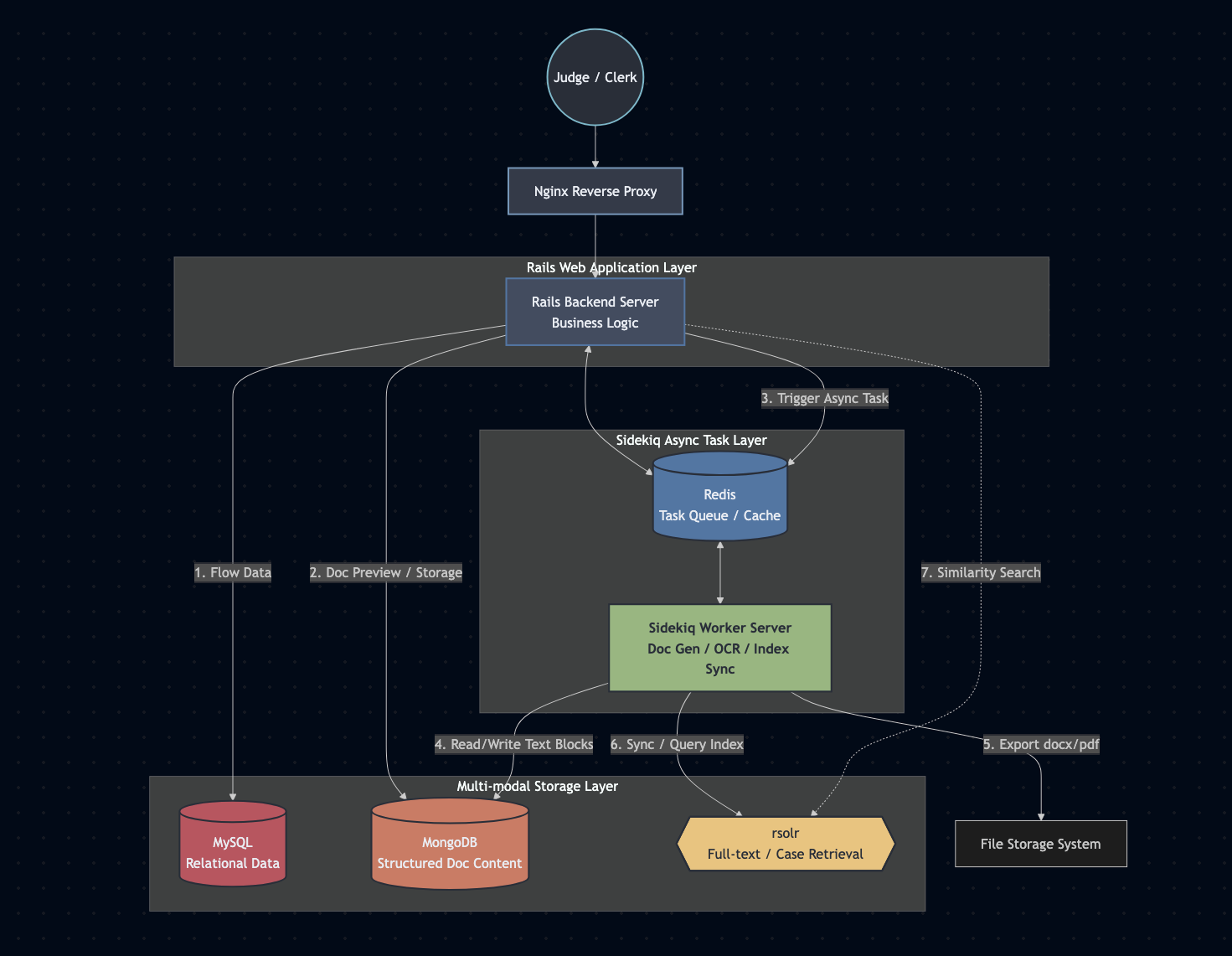
Core Technology Stack
- Backend: Ruby on Rails (Full-stack)
- Web Server: Nginx (Reverse Proxy)
- Relational Database: MySQL (Case metadata, parties, workflow states)
- Document Storage: MongoDB (Structured legal documents)
- Search & Similarity Engine: Apache Solr
- Cache & Queue: Redis
- Async Processing: Sidekiq
- Deployment: On-Site court environment
Architecture Characteristics
- Nginx routes requests to Rails backend
- Sidekiq handles heavy background jobs:
- OCR processing
- Document structuring
- Similar case indexing
- MongoDB stores structured document data
- Solr supports full-text search and similarity matching
- Redis used for caching and job queues
4. Technical Challenges & Solutions
Large-Scale Document Processing
Challenge
- Courts process massive volumes of unstructured legal documents daily.
Solution
- OCR + background processing via Sidekiq
- Document parsing decoupled from request lifecycle
Legal Similarity Search
Challenge
- Efficiently finding legally relevant similar cases.
Solution
- Hybrid approach:
- Text vectorization
- Rule-based constraints (case type, amount)
- Solr optimized for legal text search and ranking
Judicial Reliability & Trust
Challenge
- Automation must not override judicial authority.
Solution
- Human-in-the-loop workflow
- Full editability and source traceability
- No automated verdict generation
5. My Responsibilities & Achievements
Responsibilities
- Led on-site requirement analysis with court staff
- Translated judicial workflows into technical designs
- Oversaw system deployment within court environments
- Managed requirement changes and iteration cycles
- Coordinated developers, stakeholders, and court officials
Key Achievements
- Led end-to-end project delivery across multiple court deployments, ensuring on-time launch and stable operation in on-premise judicial environments
- Drove requirement analysis and process modeling by working closely with judges and court staff, translating legal workflows into actionable system designs
- Coordinated cross-functional teams (backend, frontend, QA, deployment) to deliver iterative releases aligned with contract and regulatory requirements
- Established effective communication and delivery mechanisms between legal stakeholders and engineering teams, reducing requirement ambiguity and rework
- Built and managed the development team, overseeing task breakdown, progress tracking, and delivery quality throughout the project lifecycle